
In the third year of a full-scale war with Russia, a significant part of Ukrainian lands near the border is still in the hands of businessmen and local residents. For decades, officials have claimed to solve this problem, but to this day, the border area does not fully belong to the state. Moreover, after the Russian invasion, the problem of the “private border” has taken on new colors.
The fact is that in February-March 2024, the Ukrainian authorities actively undertook the construction of defensive fortifications from Russia and Belarus. It would seem that during the war the need for such work is an axiom. But new realities have exposed an old problem - the presence of private lands along the Ukrainian borders.
According to BBC Ukraine, in March, landowners in one of the settlements in the Rivne region approached the group that was building fortifications and issued an ultimatum: “We will not allow this, we will stand as a human shield!”.
They tried to explain to the angry residents that the threat of a second invasion from Belarus had not disappeared and that they needed to prepare. But in this particular situation, logical arguments did not work. “We will meet them with white flags,” was the response of the landowners.
The military and local government representatives we spoke with do not rule out the escalation of such conflicts, especially on the eve of the sowing season. This is because the issue of returning strategically important defense lands near the border to the state has not been resolved in Ukraine for decades.
What is a “private border”?
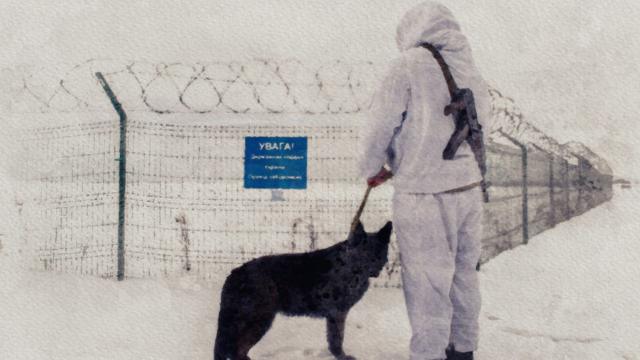
The length of the Ukrainian land border is 5,368 kilometers. Almost 2,000 kilometers are with Russia, and over a thousand more with Belarus. Border lands also include lands 30-50 meters wide along the border, and up to 2 kilometers wide near the border with Russia and Belarus.
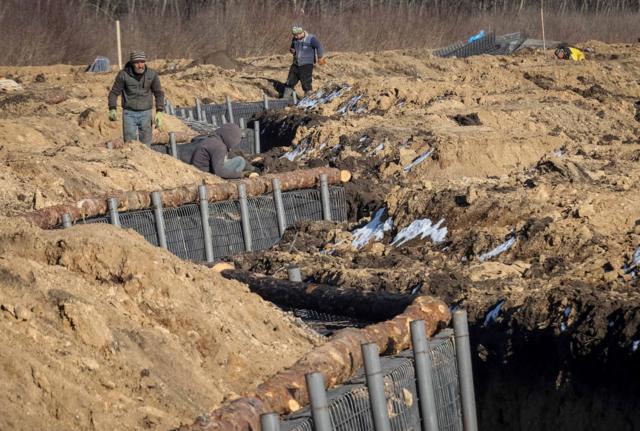
PHOTO AUTHOR, REUTERS Photo caption, Construction of defensive fortifications along the state border in the Kharkiv region, March 2024
But it so happened that a large part of this land ended up in private ownership in previous years. On the Internet, you can find many reports about how local authorities in border regions transferred this land to private hands free of charge.
This happened under almost all governments and presidents. Some decisions were later appealed, others were ignored, but gradually the problem of the “private border” acquired a nationwide character. And with this situation, Ukraine entered a full-scale war with Russia.
The fact is that despite the agricultural purpose of these lands, their owners did not always engage in gardening there. Often, conditions were organized in these territories for smuggling and illegal migration - this "business" brought in more money than agriculture.
“In practice, these private plots are a huge problem, because the landowners were able to organize their own corridors for illegal activities – illegal migration and smuggling,” border guard Serhiy tells us on condition of anonymity (name changed).
Some even posted their own guards on the border, had their own private security service and observation towers. In a conversation with us, Serhiy immediately recalls the high-profile story of almost a decade ago with the “private border” in Transcarpathia.
The loudest scandals
In 2015, the country was shocked by the information that in Transcarpathia along the border with Hungary, a “private border” was fully functioning, on which not only was there separate security and engineering structures from the state, but also separate rules that had nothing to do with Ukrainian law.
Land plots on the border with a total length of about 150 km (for comparison, the length of the border with Hungary is 137 kilometers) were registered to various owners as agricultural land. Of course, no one sowed corn on them - these were points for smuggling. Starting from cigarettes, weapons and drugs - ending with illegal migrants.
Ukrainian border guards did not have access to these areas. “Private owners set up observation towers there, where a practically parallel security structure operated, working not for the state, but for the land owner. There were often conflicts with border guards there, or the border guards themselves began working for them for bribes,” says border guard Serhiy.
And although all those plots officially belonged to different people, law enforcement officers attributed this “large farm” to Attila Horvat, nicknamed “Doki.” He was called the “king of smuggling” and suspected of controlling illegal flows from Transcarpathia to Hungary.
In November 2017, Ukrainian security forces organized a grandiose special operation against him.
“Doki” was detained spectacularly – with helicopters, armed special forces and publicity in the Ukrainian media. A criminal investigation was launched against him, and in 2019 the case was transferred to court, although Attila Horvat never ended up behind bars. In April 2020, he died in a car accident – he crashed on the Kyiv-Chop highway near Rivne. The lands controlled by “Doki” were returned to the state.
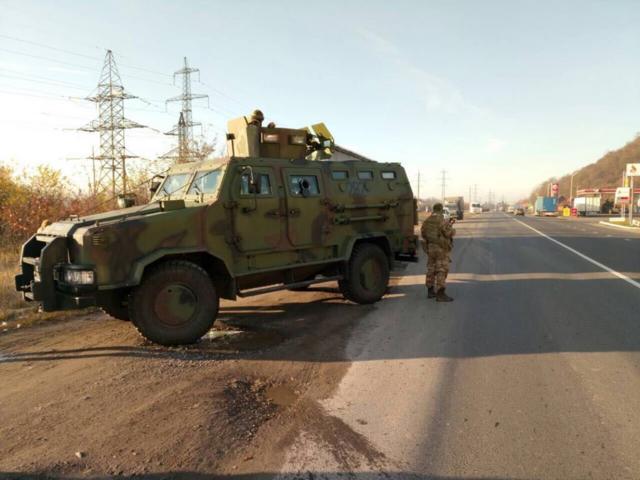
PHOTO AUTHOR, State Border Service of Ukraine Photo caption, Detention of the owner of the “private border” in Transcarpathia, Attila Horvat, in November 2017
Another scandal concerns the “private border” on the opposite side of Ukraine, in the Kharkiv region. Here, control over the territories near the “Goptivka” checkpoint in the Dergachi district is attributed to businessman and former head of the internal security department of the State Border Guard Service, Vadym Slyusarev.
A number of media outlets called Slyusarev the “shadow curator” of President Volodymyr Zelensky’s headquarters in the Kharkiv region, and also reported that his current companies were involved in smuggling investigations. And although the businessman is not even a member of the Servant of the People party, he did appear at joint events of Zelensky’s team in Kharkiv during the election campaign.
So, during the second round of the presidential elections on April 21, 2019, the then head of the Kharkiv “Servant of the People” party, and today already a People’s Deputy Pavlo Sushko, published a post with words of gratitude: “This is only a small part of the Kharkiv headquarters team of Volodymyr Zelensky! Thank you to our great Ze!Team!” Under this post, he posted a group photo of the team – in the background there is a man with two raised hands. This is Vadym Slyusarev.
Back in 2019, Volodymyr Zelensky told reporters that he did not communicate with Slyusarev, but admitted that he was indeed helping Pavlo Sushko in Kharkiv. The president did not specify what exactly. “He is helping Pasha (Pavlo Sushko – Ed.). I know Pasha very well. Pasha is our face,” Zelensky said in response to a question from a Radio Liberty journalist.
In 2021, the Kyiv Post and the Organized Crime and Corruption Reporting Project (OCCRP), citing Romanian customs declarations obtained by journalists, reported that companies later owned by Slusarev had been smuggling Chinese cigarettes into the European Union for a long time. According to the journalists, two Ukrainian companies – Duty Free Odesa LLC and Travel Retail Ukraine LLC, co-owned by Slusarev, imported Chinese brand Regina cigarettes into Ukraine.
Law enforcement officers were involved in this case, but the investigation never established the fact of Slyusarev's involvement in illegal actions.
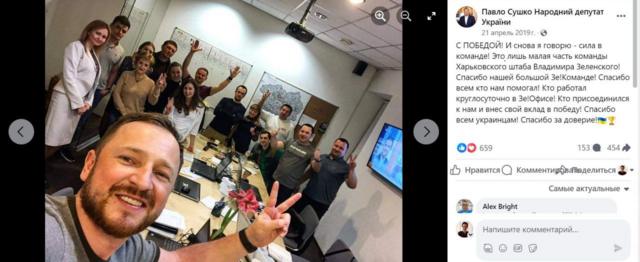
PHOTO AUTHOR, FACEBOOK PAVLA SUSHKA Photo caption, Vadym Slyusarev among members of President Zelensky's team in Kharkiv region. He stands in the background with his hands raised
Slyusarev himself denies all these accusations against him. He filed a lawsuit against the journalists and won the case late last year. The court of first instance found the information about Slyusarev's involvement in smuggling unreliable. The journalists who authored this investigation told us that they have filed an appeal, which is still pending.
As for the border lands, Slyusarev does not deny that he owns such plots. His lawyer Olena Bardina told BBC Ukraine that her client is indeed the owner of the lands near the state border in the Kharkiv region. Two of his companies (Frontera LLC and Tiera LLC) own the territory in Dergachiv district, which was used for economic activities.
But, the lawyer emphasizes, with the beginning of a full-scale war, the indicated land plots found themselves in the actual epicenter of hostilities, the institutions that were located there were destroyed, and the owner - Vadym Slyusarev - has no access to them.
And Slyusarev insists that the state did not contact him about the transfer of these plots.
Olena Bardina assures: no state bodies, including the border service, have contacted the landowners regarding these border areas. “If there is such a need, the companies will have no objections and are ready to provide any necessary assistance to the state,” the lawyer said.
All information in the media about Slyusarev's involvement in smuggling is called unreliable by his lawyer, as is his participation in the activities of the political party "Servant of the People" or close relations with the current leadership of the border service.
"In 2015, Vadym Slyusarev completed his service in the State Border Guard Service of Ukraine and since then has been engaged exclusively in entrepreneurial activities. He is not a public figure, and is not involved in any political or public organizations and initiatives.".
How much land is in private hands?
Today, the problem of the “private border” is becoming even more acute – a full-scale Russian invasion is underway, and therefore the challenges on the border have only increased. Plus, after the summer counteroffensive, which did not yield the expected results, the Ukrainian authorities have begun large-scale construction of defense structures in the border area, particularly in the north and east, to thwart possible aggressive plans by Russia.
The government has allocated 20 billion hryvnias for the construction of high-quality concrete fortification systems and engineering barriers in 2024. All regions of the country have been involved in these works, and both civilian and military structures are participating in them.
Even before the full-scale invasion, in August 2021, the NSDC, at its meeting, instructed the Cabinet of Ministers to conduct an inventory of lands along the border and transfer them to the border guards for permanent use. The owners of these plots were to be offered to sell the land to the state, and in case of disagreement, to forcibly seize it. But, according to our data, nothing has actually changed since then.
The State Border Guard Service told us that as of March 2024, it is necessary to allocate more than 23 thousand hectares of land near the border. But only 25% of this work has been completed.
More than 7 thousand hectares are still privately owned – this is the area of the city of Cherkasy. Another 6 thousand hectares are municipally owned lands. They must be alienated in order to accommodate border and engineering infrastructure. Of these, a significant share – 4.4 thousand hectares – falls on the border with Russia and Belarus.
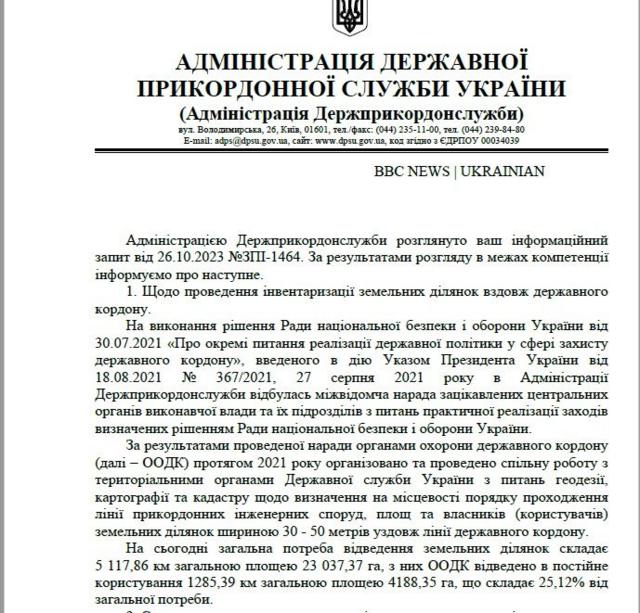
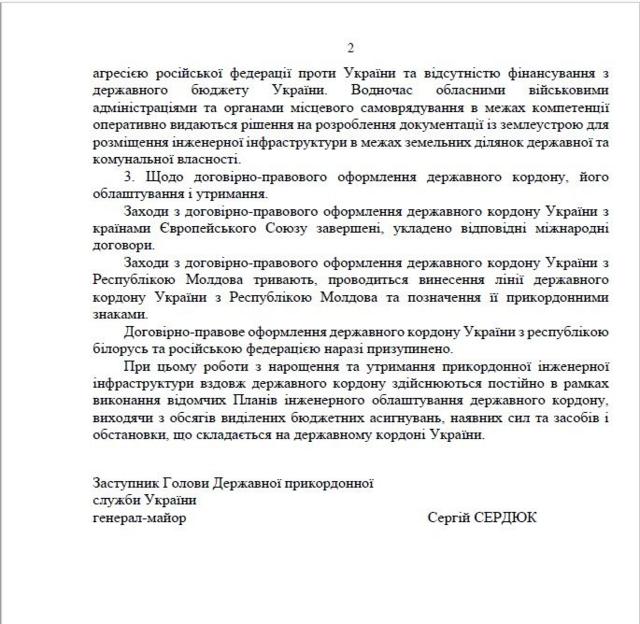
As the border guards explain, regional administrations should have been responsible for purchasing the plots, but they have not done so since the beginning of the Great War.
“According to letters from regional military administrations, measures to buy out and forcibly alienate land plots were not carried out in 2022 due to the large-scale armed aggression of the Russian Federation against Ukraine and the lack of funding from the state budget of Ukraine,” the department told the BBC. These works were not carried out in 2023 either.
They admit that the most difficult situation is with private lands on the border. “The biggest difficult issue remains the plots that are in private ownership, as this limits the possibility of their use in the interests of protecting and defending the state border,” explains Andriy Demchenko, a spokesman for the border agency.
According to him, it is impossible to install engineering barriers and structures, lay roads for border patrols, or place control and surveillance equipment on private land without the owner's permission.
Trials are still ongoing on some areas, and the prosecutor's office is trying to return previously illegally privatized lands to the state.
Separately, work is underway to transfer lands from the nature reserve fund to the border guards - this is a little over 2 thousand hectares. The withdrawal of these plots is also a complex bureaucratic process, which involves central authorities.
What to do about it?
The end of this “eternal” problem should be put by the law adopted on February 24, 2023. It was introduced by 40 deputies of the Rada, led by the former border guard of the Eastern Directorate, and now a deputy from the “Servant of the People” Yuriy Zdebsky. Their initiative was simple and maximally effective in theory – during the war, land for the needs of border guards can be taken without the permission of land users.
It would seem that Ukrainian border guards have received all the necessary tools in their hands to finally take control of border lands 2 km wide in the east and north (on the border with Russia and Belarus) and 30-50 m wide in the west. But in practice, it turned out not to be so easy.
“With this law, we have closed the border,” Zdebski assures the BBC. He is confident that after the lifting of martial law, private lands will return to their owners. “The war will end – they will give them these territories, dig trenches and plant whatever they want there.”.
But people themselves are not always ready to wait, especially with the onset of spring sowing.
One of the officers of the Armed Forces of Ukraine, who is overseeing the process of building defense lines in the north, says that local residents are unhappy. Major conflicts have been avoided so far, but not everyone agrees that a trench should be dug or a bunker (long-term defense point) should be installed on their site.
“Civilian contractors are usually involved in the arrangement. But since new lines of fortifications are being built now, this issue will arise in the near future, when people will sow gardens and fields. I myself am curious how this will be resolved,” the military man tells us.
Local authorities assure that the forced land acquisition is still being worked out. “This issue requires partial settlement, all relevant services are currently working on it. But this does not prevent us from building fortifications in the Chernihiv region today,” the head of the Chernihiv regional military administration, Vyacheslav Chaus, told the BBC.
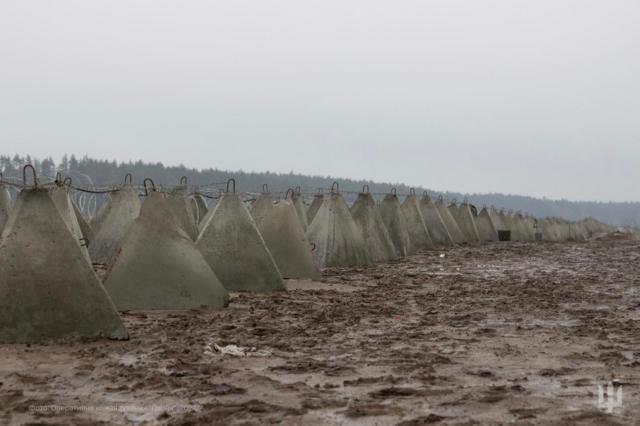
PHOTO AUTHOR, OPERATIONAL COMMAND “NORTH” Photo caption, In Chernihiv region, as well as on other sections of the border with the Russian Federation and Belarus, since the beginning of spring, defensive lines have been rapidly being built. Fortifications are also being built on private lands
“Today, the construction of fortifications is being carried out according to plan and there are no obstacles from the population and business,” he emphasizes.
But we found out that the situation is not calm everywhere. According to BBC Ukraine, in some regions there have already been cases of disputes between landowners and military personnel who are building defensive fortifications. People are threatening to go on protests because the state is building engineering structures on their lands.
Our sources in law enforcement agencies claim that the prosecutor's office is already working with "particularly recalcitrant" landowners. According to some reports, it received a non-public instruction from the authorities to intensify this issue at the end of last year.
Although the authorities have not publicly announced the intensification of this work, recently news about the seizure of border lands has increasingly appeared on the websites of regional prosecutors' offices.
For example, the Kharkiv Regional Prosecutor's Office reported on March 11 that it had achieved through the court the return of 24.3 hectares to state ownership, and on March 14, another 16 hectares of land located along the Ukrainian-Russian border.
Similar decisions were also reported by the Chernihiv and Sumy prosecutor's offices.
Ukraine did not prepare for Russia's invasion, and therefore did not care about seriously improving its borders, the opposition believes.
Iryna Friz, a member of the European Solidarity Party and a member of the National Security Committee, says: “The threats are obvious and the lack of fortifications along the entire border not only poses a security risk, but can also harm national security.”.
According to her, not all border residents are understanding and ready to give their lands to the state, so decisive action is needed from the authorities. She categorically rejected the government's explanation that getting rid of the "private border" is prevented by the war and lack of funding.
"I emphasize that our partners warned President Zelensky long before the invasion began, and the first substantive conversations about the real threat began a year later. However, even with full power in the country, Zelensky's team did not properly prepare fortifications in the most vulnerable areas. This cost us many civilian and military lives.".
The authorities are being called upon to take responsibility and resolve this issue. Russia's full-scale invasion has been going on for three years, and today there are legislative mechanisms for returning private lands to the state. The only question is whether there is the political will to do so.

