
A portrait of the daughter of Hetman Pavlo Skoropadsky inspired the Ukrainian diaspora in Europe for centuries. It was passed around in the form of postcards, and the original was thought to be lost forever in the maelstrom of World War II. Then, suddenly, the Hetmanate Museum in Kyiv received an unexpected letter from a German family.
Mysterious stranger
In the picturesque town of Oberstdorf, nestled in the Bavarian Alps in southern Germany, a family of local farmers has kept an unusual portrait for many years.
It depicts a young and beautiful woman wearing a wreath of flowers, a white embroidered dress, and a colorful necklace. She looks deeply into the eyes of everyone who looks at the painting. This gaze seems to hide a difficult but fascinating story.
But which one? Who is this mysterious stranger whose portrait a 15-year-old German boy found 40 years ago.
His daughter, Katharina Schall, now a grown woman, says that, like her father, she fell in love with the painting at first sight.
“Colors, flowers, jewelry, and a woman's charisma are some kind of magic,” she said in an interview with the Ukrainian publication Marie Claire.
Katarina hung the portrait in her apartment. She says that everyone who came to visit would notice it and ask who this woman was and what story her image was hiding.
Then the woman decided to investigate and find out the stranger's name. At that time, Katarina only knew how the painting came into her family.
In the early 1980s, when Katharina's father was 15 years old, he saw an ad in the local newspaper that a house in Oberstdorf was being demolished, the woman told Marie Claire magazine.
The boy collected stamps and hoped to find rare specimens for his collection in the house. Instead, he saw a painting standing just outside the door.
The portrait of the woman struck him, and he asked the owners what would happen to it. But the owner replied that if the painting was not taken away, it would end up in the trash. So Katharina Schall's father brought the portrait home and hung it in his children's room.
Didn't expect to find
At the same time, the portrait that adorned the Schall family's house, and about which they knew nothing, was very well known among the Ukrainian diaspora, historian Oleksandr Alferov told BBC Ukraine.
The woman in the portrait is the daughter of the last Hetman of Ukraine, Pavlo Skoropadsky, Elizaveta. She was her father's loyal assistant and an active participant in the Hetman Movement, leading the Union of Hetmans-Statesmen in the 1960s and 1970s.
The portrait of the Hetmanovna, painted by the artist Olga Mordvinova around the 1920s, was well known in the emigration thanks to the postcards that were mass-produced with it. Such a postcard is also in Alferov's own collection.
According to him, the portrait of the Hetmanovna became for the Ukrainian diaspora “the personification of a Ukrainian aristocrat, not even by origin, but an aristocrat of spirit.”.
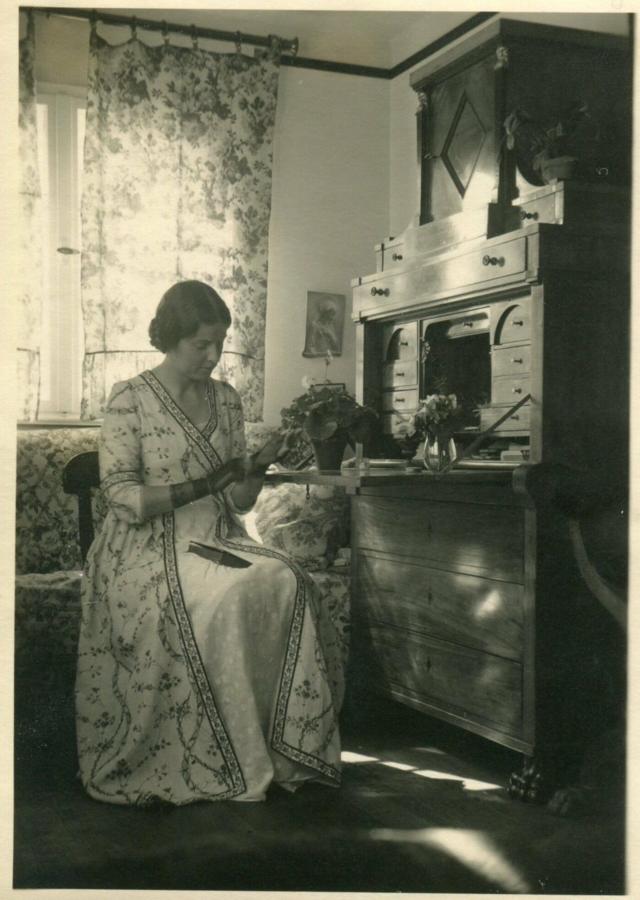
PHOTO AUTHOR, ARCHIVES OF THE HETMANSHIP MUSEUM Photo caption, Photo by Elizaveta Skoropadska from the archives of the Hetmanship Museum, where many of the family's belongings are kept
However, the fate of the painting itself was unknown. Skoropadsky's youngest daughter, Olena Pavlovna Ott-Skoropadska, spoke about its existence and the fact that the painting had disappeared when she came to Ukraine, the historian says.
Elizabeth's portrait was not in the family collection of Hetman portraits, created by the Skoropadskys' friend Olga Mordvinova, which were later transferred to the Hetmanate Museum.
Researchers assumed that the portrait was lost during World War II, and did not even hope to find it.
Therefore, when in May 2021, the employees of the Hetmanate Museum received a message from the German woman Katarina Schall, they were very surprised – and delighted.
Katarina came across the museum in Kyiv through a Google image search and wrote an email asking who this woman was.
“Since then, we have had the feeling that the Hetmanovna is “returning,” the museum researchers say emotionally. “This was her most cherished dream – to live in a free Ukraine.”.
Dedicated to the independence of Ukraine
Historian Alexander Alferov is convinced that the portrait found by the Schall family is the original, not one of the copies.
After all, it was found in the city where Elizaveta spent her last years and where she was buried, as was her father, Pavlo Skoropadsky.
Elizabeth was born in 1899 in St. Petersburg and would visit her father's estates in Chernihiv region every summer. She was fascinated by Ukrainian history, especially the independence movement and the Cossacks, according to the Hetmanate Museum.
The news of her father's hetmanship became a decisive event in the life of a young romantic girl.
In his memoirs, the hetman recalled his children and how they experienced the times of the Ukrainian Revolution and the beginning of emigration.
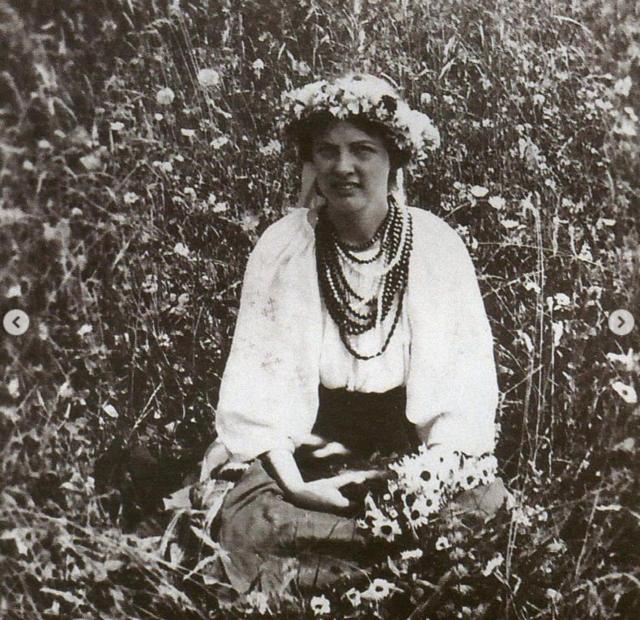
PHOTO AUTHOR, ARCHIVE OF THE HETMANSHIP MUSEUM
As Olena Ott-Skoropadska recounted, Elizabeth “gave in raptures to the general mood of enthusiasm then prevailing in Ukraine for the construction of a new Ukrainian Hetmanate.” And that is why she took the uprising against her father and the fall of the Hetmanate so painfully, historians explain.
The Skoropadsky family had been in exile since 1918 – first in Lausanne, Switzerland, then in Wannsee near Berlin from 1921 to 1945.
And after the war, she moved to the town of Oberstdorf in Bavaria, where Elizaveta was actively involved in political activities and the development of the Hetman movement until her death in 1976.
Despite the fact that the Hetman family was very well-known in emigration, they did not have a huge fortune and were forced to work, says historian Alferov.
The family's memoirs contain stories about how they were forced to pawn their dinnerware and other family valuables almost every month.
“Perhaps in the turmoil of events after the death of Elizaveta Skoropadska or during her numerous moves, the portrait was lost or fell into the wrong hands,” says the researcher.
The Skoropadskys in emigration were ordinary people, lived modestly, they did not flaunt their origin, and therefore local residents may simply not know what kind of family they were, explains Alferov.
The portrait will return
After Kataryna Schall wrote to the Hetmanate Museum, and the museum's deputy director Lyudmila Bevz explained to her who was in the portrait, the correspondence ended.
Freelance journalist Mykola Hulk, who was preparing a story about Hetman Skoropadsky's family, managed to resume negotiations with the Shall family.
He learned about the amazing portrait find at the museum, the editorial office of Marie Claire magazine told BBC Ukraine.
As a result of a long correspondence, the museum and the magazine's editorial office agreed to transfer the portrait to the Hetmanate Museum.
And now all the subtleties related to the documents are being coordinated, because the portrait is in Germany, and in Ukraine there is a war, Marie Claire explained.
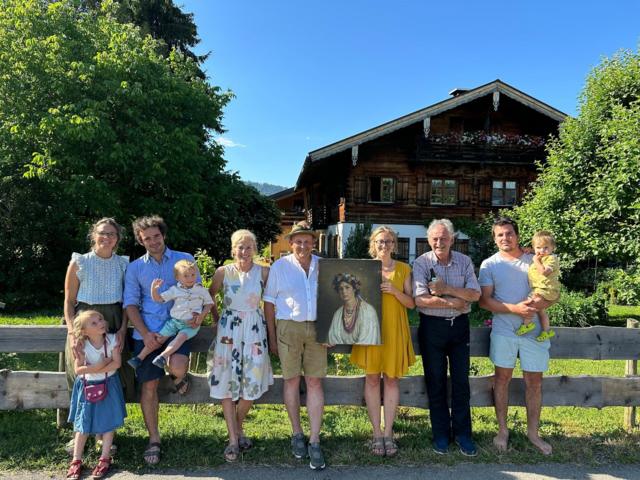
PHOTO BY KATHARINA SCHALL Photo caption: The Schall family is the father and mother of Katarina and her brother. The children are married and have their own families. The head of the family has three grandchildren
The Schall family is proud that they managed to preserve the historical monument.
“The story of the woman depicted in the portrait is extraordinary. Now, as then, Ukrainians have to go through a lot of suffering. We hope that peace will soon come to Ukraine,” they said.
Hetmanivna embroidery
The elegant white shirt worn by Elizaveta Skoropadska in the portrait is similar to another embroidery she created, which is kept in a Kyiv museum.
Elizabeth found solace in art. She was a talented sculptor and writer, and was engaged in embroidery. A shirt in the Hetmanate Museum testifies to the creative skill of the young woman.
The exquisite portrait of the girl and her outfit inspired the Ukrainian brand “Ethnodim” to reconstruct Elizabeth’s shirt. The ornament used motifs of Poltava embroidery from historical archives.
