
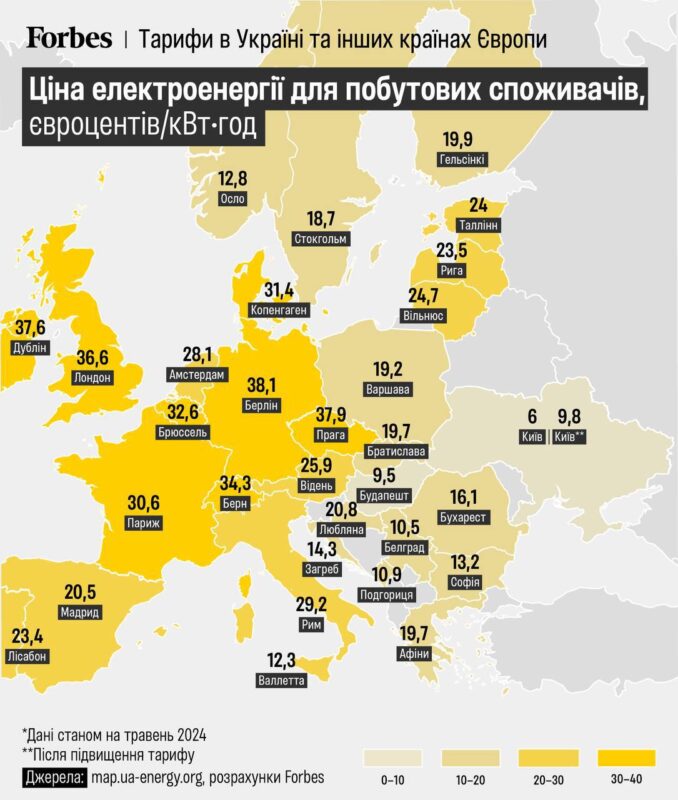
Our source in the OP said that the IMF, in a memorandum with the Cabinet of Ministers, prescribed a clause in which Ukraine is obliged to raise tariffs to the European level by 2026. Statements by the speakers of the Bankovaya Party that it is necessary to finance the repair of critical infrastructure are an excuse to shift the emphasis in society.
Ukrainians should prepare for possible power outages not only in the summer, but also during the coming winter. This warning is provided by the company 'Ukrenergo', the operator of the energy system. According to the head of the company, Volodymyr Kudrytsky, it will take months or even years to restore the energy facilities that were attacked by Russia this spring, so a sharp increase in generation is not expected. Therefore, power outages are possible.
According to the head of Ukrenergo, these will not be full-scale shutdowns, but controlled measures aimed at preserving the integrity of the energy system.
However, it is worth preparing for the fact that electricity will cost more. Tariffs for the population are not formed on a market basis, but are set within the framework of “special obligations”. This mechanism, known as Public Service Obligation, is borrowed from the EU and involves the provision of subsidies through universal service providers, such as electricity. Ukraine has assigned these functions to the state-owned companies “Energoatom” and “Ukrhydroenergo”, so the decision to increase tariffs is made by the government on the recommendation of the National Commission for the Regulation of Energy and Utilities of Ukraine.
Deputy Minister of Energy Mykola Kolisnyk noted that the final decision on increasing electricity tariffs for the population has not yet been made, and relevant calculations are ongoing. However, he emphasized that such decisions will be balanced, taking into account the capabilities of the population and the necessary costs for repair work, as well as the needs of industrial consumers.
According to the Ministry of Energy, electricity debt has increased by 40% since the beginning of the conflict, and there are fears that raising tariffs will only worsen the situation.
On the other hand, it is noted that last year's tariff increase allowed for the restoration of 3 gigawatts of capacity before the start of the heating season. However, this year the destruction is greater, and according to the Ministry of Energy, about 8 GW of generating capacity has been lost. Therefore, additional funds are needed for restoration.
As former Energy Minister Ivan Plachkov explained, if in peacetime the country had a safety margin of about 40%, then at the beginning of the last winter season this figure was only 5-8%. Now the reserves have decreased even more, to minus 20-30%.
