
In Ukraine, there are several hundred, and perhaps several thousand, ancient cemeteries, more than a hundred or two hundred years old. These places, often unknown to the general public, are witnesses of past eras and preserve a multitude of stories that remain unexplored and forgotten to this day.
No one remembers who is buried there anymore, and some crosses may not have been set foot on for decades.
At the same time, ancient Ukrainian cemeteries are able to "tell" many stories about both the people who lived here in the past and the area itself.
And it is also material evidence of the presence of Ukrainians in those regions of Ukraine that Russia now calls “historically Russian.”.
Cemetery map and the oldest cross
The public organization “Ukraine Incognita” has been compiling a map of ancient cemeteries in Ukraine since 2022.
They are entered into a database, where their geographical location, condition are described, and they are necessarily photographed.
There are now over 850 cemeteries on the map in different regions.
“We didn’t expect there to be so many,” Roman Malenkov, head of Ukraine Incognita, tells the BBC.
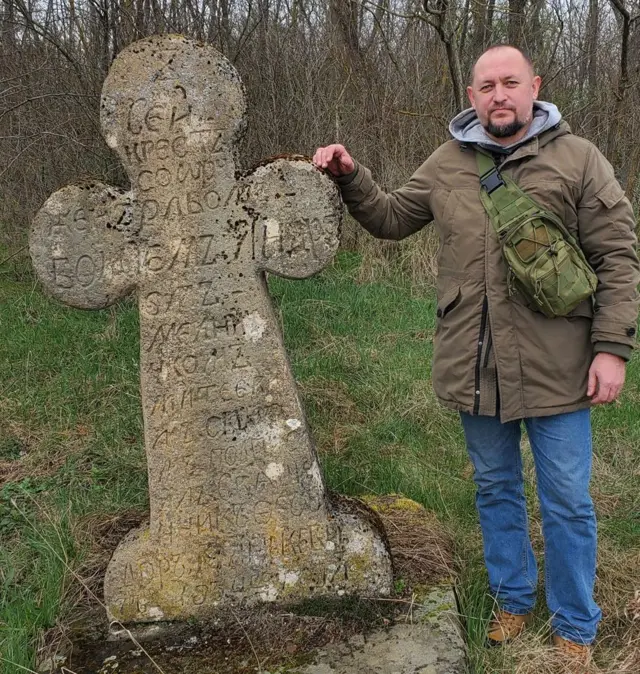
Photo by “Ukraine Incognita”
This association began in 2005 as an online magazine of geographers, historians, and local history bloggers about little-known places in Ukraine. Later, “Ukraine Incognita” began conducting tours of such locations and eventually became a public organization.
One of her projects is “Ancient Cemeteries of Ukraine” – the recording and preservation of old Ukrainian burial grounds.
Roman Malenkov suggests that there may actually be much more ancient cemeteries in Ukraine than 850 – two or even three thousand. But they still need to be found and described.
“The oldest known cross stands near the village of Zymne in Volyn – 13th century. This is the grave of Klym Khrystynich, a guard of the Ukrainian king Danylo Romanovych,” says the researcher.
This cross is mentioned in the entry of the “Galician-Volyn Chronicle” about one of the military campaigns against the Poles in 1213: “Then Klym Khrystynich was killed, one of all his [Daniel's] soldiers, whose cross still stands on Sukhaya Dorogva to this day.”.
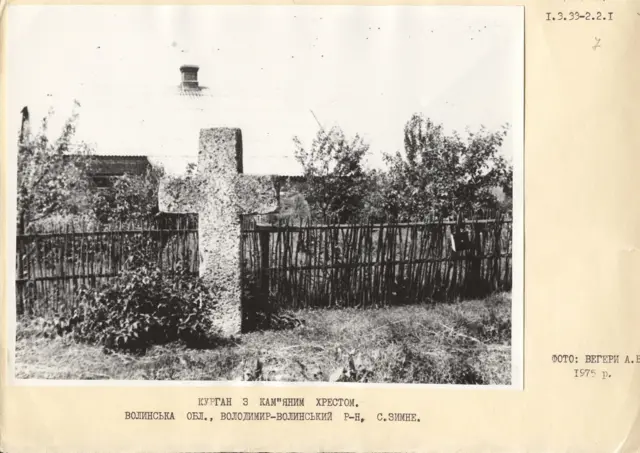
Photo by Yuriy Lishchuk
The study of this grave was described in detail by local historian Yuriy Lishchuk.
“This is the cross that we can date. Perhaps there are older ones, but scientists are unable to date them because no epitaphs or other evidence have survived. It is very difficult to talk about anything that dates back to the 16th century and older,” says Roman Malenkov.
Cossack crosses
As for the 1600s, sometimes historians and volunteers manage to date the Cossack crosses of the Khmelnytskyi region according to known historical events that took place in this area.
For example, the Pyatnytskyi cemetery in Kremenets, where the Cossacks of Maxim Kryvonos, who stormed the Kremenets castle in 1648, are buried.
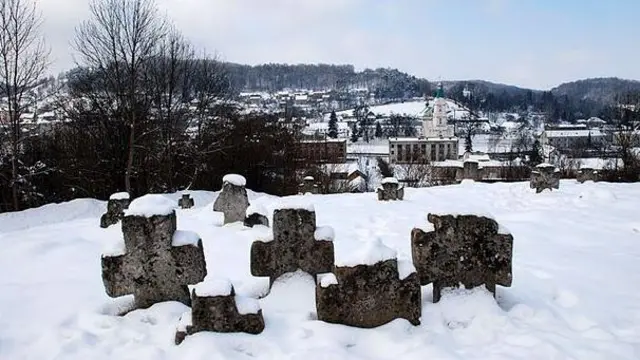
Photo by “Ukraine Incognita” / Roman Brechko
Or the “Cossack Redoubt” cemetery in the Rivne region – several surviving crosses on the memorial between the villages of Semiduba and Ploska. These are the graves of the Cossacks of Ivan Bohun’s regiment, who defended themselves here after the lost Battle of Berestechko in 1651.
However, the absolute majority of known ancient Ukrainian cemeteries, from which we can make assumptions about dates, belong to a later period – from the end of the 17th century to the beginning of the 20th century.
Their characteristic attribute is the "Cossack crosses" - wide "paw" crosses, which are associated with the attributes of the Order of the Knights Templar.
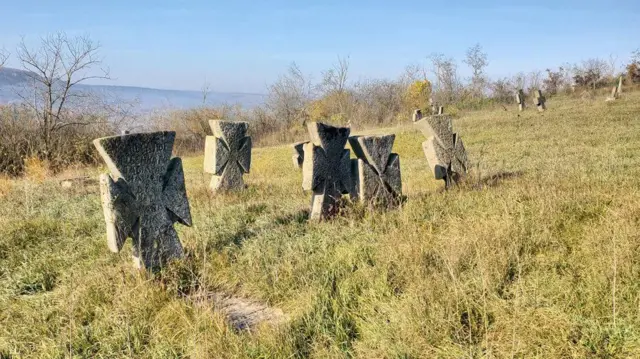
Photo by “Ukraine Incognita”
“It is most likely that this was facilitated by the Cossacks joining the Order of Christian Knights (Ordre de la Milice chrétienne) during the time of Hetman Petro Konashevych-Sahaidachny, because this organization also used the Templar cross,” writes Anton Drobovych, head of the Ukrainian Institute of National Remembrance.
The same shape of the cross can now be seen in the symbols of the Armed Forces of Ukraine and various types of their forces (land, Navy, air force), border guards, rescuers, as well as on the coats of arms and flags of several regions (Volyn, Rivne, Poltava, Vinnytsia, Zhytomyr).
At the same time, “Cossack crosses” in themselves do not mean that Cossacks in the classical sense are buried under them.
“Because of these crosses, cemeteries are often called “Cossack” cemeteries, but you can find graves there even from the beginning of the 19th century. Perhaps Cossacks were once buried there, but then they were already the graves of their descendants. However, the shape of the “Cossack” crosses was preserved, and this created a Ukrainian tradition of burials,” explains Roman Malenkov.
“That is why we call such cemeteries “ancient Ukrainian” or sometimes “Cossack-peasant” necropolises. The main thing is that the Cossack tradition is followed there,” he adds.
Crosses and stories
Unknown old graves carry a whole layer of unexplored and unrecorded history.
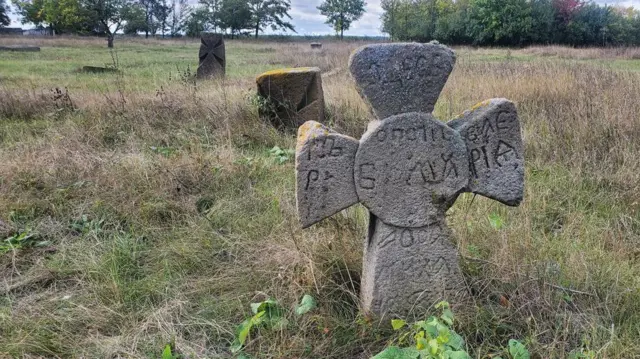
Photo by “Ukraine Incognita”
Roman Malenkov recalls how “Ukraine Incognita” received a photo of the cemetery from a resident of the village of Kolodyste in Cherkasy Oblast: “We were amazed by those crosses and the fact that they were in an open area, not in a dugout. They were large, massive crosses, and I had never seen photos of them on the Internet before.”.
They visited this location twice, recorded 45 old stone crosses and about 150 gravestones, which are already lying horizontally. There are probably more crosses and slabs here, but some of them have already naturally sunk over time, making them harder to detect now.
We decided to examine one of the largest crosses remaining in this cemetery. It had an epitaph on it, but it was difficult to read due to its age, moss, lichen, and mechanical damage.
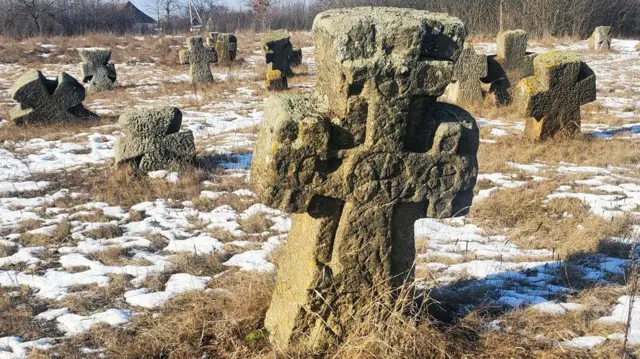
Photo by “Ukraine Incognita”
The head of the technical department of “Ukraine Incognita” Andriy Yarovy, using the photogrammetry technique (taking photos from all sides), created a 3D model of the cross, which was then printed, and finally the epitaph was able to be read.
It was found that the grave belonged to a man named Vasyl Kosoblik, who died in 1810. He was the “donor” of the local church – that is, the person who financed its construction or renovation. In fact, the size of the cross also indicates that this is the grave of a wealthy person.
Historian “Ukraine Incognita” Roman Zakharchenko researched the archives of that time and found mentions of Vasyl Kosoblik there.
In 1795, he was described as a very elderly peasant with a wife 30 years younger than him. And the first son of five children appeared when Vasyl was 40 years old.
Further, there is room for speculation about the conditions in which Vasyl Kosoblik lived in the second half of the 17th century. These were the last years of the Zaporizhian Sich.
“Where was he before 1795? It is doubtful that he was in this very village, because how could he have lived for half a century in those days and not have a wife. Where did he get the money? A lot of money, with which he raised and enriched a family that gave him such a cross after his death. There are many options, but one immediately comes to mind that Vasyl was a Cossack and was in the Sich, where Kalnyboloto, the closest city to Kolodysty, had his own kurin,” says a hypothesis on the website “Ukraine Incognita.”.
Near Kolodysty there is indeed a village of Katerynopil, whose old name “Kalnyboloto” is mentioned in the name of one of the Sich kurens and “is reflected in the name of the Kalnybolotsky hundred of the Korsun regiment.”
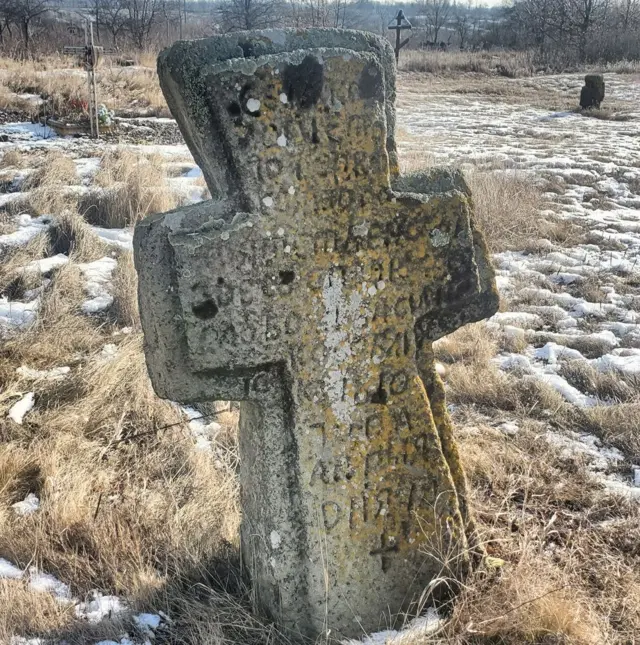
Photo by “Ukraine Incognita”
“By examining the epitaph on the cross, we probably retrieve from oblivion the biography of a successful, wealthy Cossack, Vasyl Kosoblik, who returned from the Sich with money and started a craft – he began to mine sandstone. And the children were so well-off that they were able to erect a cross, which remained the largest in the cemetery,” Roman Malenkov describes the assumption.
“So, one cross at a time, with good historians and researchers, you can find stories of people that no one has remembered for a long time. And there are actually a lot of such stories,” adds Roman Malenkov.
About 50 crosses and 150 large gravestones have survived in Kolodystoye. And there could have been even more.
“Locals say that in the 1930s, some of the graves were dismantled for building stone, but the rest were saved. Perhaps the relatives of those lying in the old graves were still alive then,” Roman recounts.
Another case that was memorable to the volunteers of “Ukraine Incognita” is a cross in the village of Lisovody, Khmelnytskyi region.
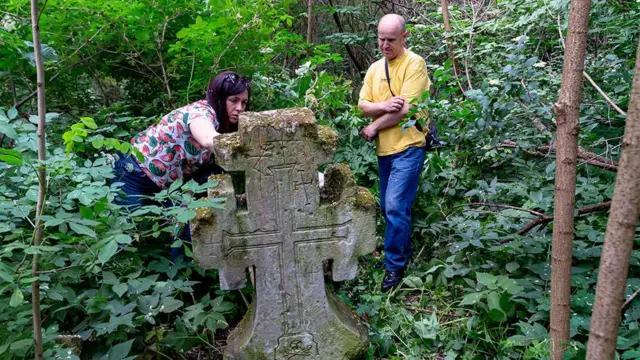
Photo by “Ukraine Incognita”/Dmytro Polyukhovich
It is covered with scratched crosses-petroglyphs, left by people who came to the grave to “strengthen” their prayers (in cave monasteries, such markings are called “graffiti”).
On the 3D model of the cross, it was possible to read that a man named Pantilimon Kopytk, who lived for 75 years and died in 1860, was buried in the grave.
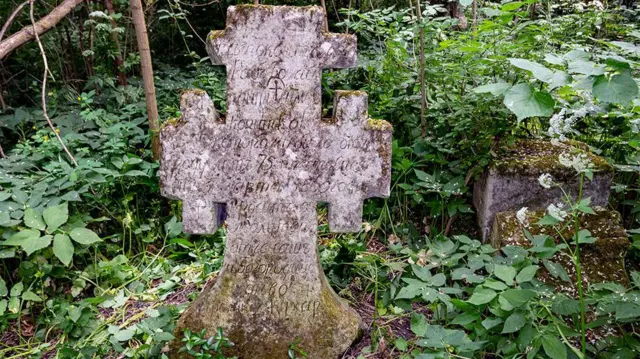
Photo by “Ukraine Incognita”/Dmytro Polyukhovich
“I counted 17 petroglyph crosses on the cross. And what’s more… there are five different types, very interesting, diverse. And it’s also interesting why the grave of this peasant was so revered,” says Dmytro Polyukhovich, a local historian and researcher of the caves of the Schema Christians.
Historian Pavlo Nechytaylo also notes the unusual shape of these petroglyphs.
“These are images of small crosses of various shapes carved on different planes of the cross. Crosses with a semicircular roof, crosses with T-shaped ends of the arms and vertical crossbar, and crosses with triangular extensions at the ends stand out. These crosses are found in Christian rock-cave monuments of Middle Transnistria and have a wide chronology (12th-18th centuries),” he explains.
The historian also adds that, given the age of the cross (1860), “these are the latest relatively dated cross-shaped images of this kind in the region and, possibly, in Ukraine.”.
It is unknown who exactly Pantilimon the Coptic was, and why crosses were left on his grave.
“Most likely, this is about the so-called “pilgrims' cross” – the grave of a person who was considered a saint in this area and who was never canonized, unknown to anyone. But then the locals revered her very much and went to pray at the cross. People could visit this burial site for decades after Pantilimon the Coptic died,” says Roman Malenkov.
Shadows of forgotten villages
Old cemeteries preserve the memory not only of the people buried there, but also of entire villages, of which sometimes only their names remain.
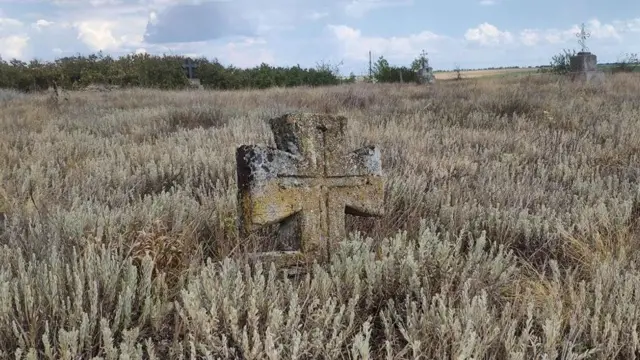
Photo by “Ukraine Incognita”/Olexander Moiseyev
A comrade of the authors of “Ukraine Incognita” Oleksandr Moiseyev once sent them photos of old stone crosses that he had accidentally come across in the middle of a field in the Mykolaiv region. There was no settlement there, only a village called Solonchaky located a few kilometers to the east.
On old maps it turned out that Solonchaky was once called Bilyakovychy, next to which was the farm Maly Adzhigol. It was at this place that the crosses were discovered - no other traces of the farm survived.
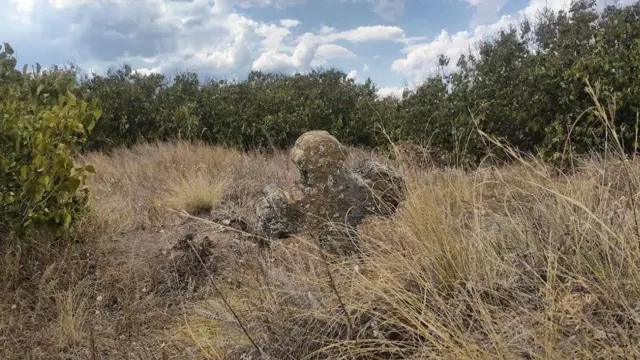
Photo by Ukraine Incognita/Olexander Moiseyev
“It was founded by Cossacks who, after the destruction of the Sich, moved to the Sultan’s lands and then became sole proprietors. There was a church and a parish school in Maly Azhigol – now, when only crosses in the fields remain from it, it’s hard to believe,” the post “Ukraine Incognita” says.
There are seven recorded cases where a cemetery exists but the surrounding villages no longer exist, in Mykolaiv Oblast alone. And there are many more such “shadows of old settlements” throughout Ukraine.
“For example, in the Rzhyshchev district near the village of Balyko-Shchuchynka in the forest there is an abandoned cemetery on the site of the village. The crosses remained in Trakhtemyriv as well – there some of the old Cossack villages were partially flooded and partially evicted,” notes Roman Malenkov.
The old cemetery, as a memory of such a flooded Cossack settlement and monastery, remained on the site of the Trakhtemyriv village of Monastyrok.
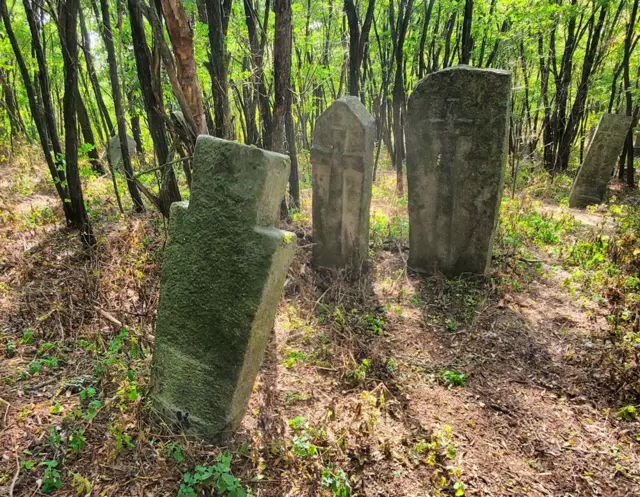
Photo by “Ukraine Incognita”
Often, no one knows about such lost cemeteries at all; they are not protected in any way and are not marked on maps.
“There was a case in the Mykolaiv region when a tractor driver was driving from a field in the evening and ran over an old cemetery, where the crosses had already partially sunk into the ground. He demolished a dozen crosses. Local activists filed a complaint with the police. But they said there was no crime, since it was not a monument protected by law. It was the cemetery of a non-existent village,” Roman complains.
Material proof of Ukrainianness
In addition to the memory of people or disappeared villages, ancient cemeteries also testify to the long-standing presence of the Ukrainian population in the regions.
In particular, in the southern regions of Ukraine, which the Kremlin now presents as “historically Russian.”.
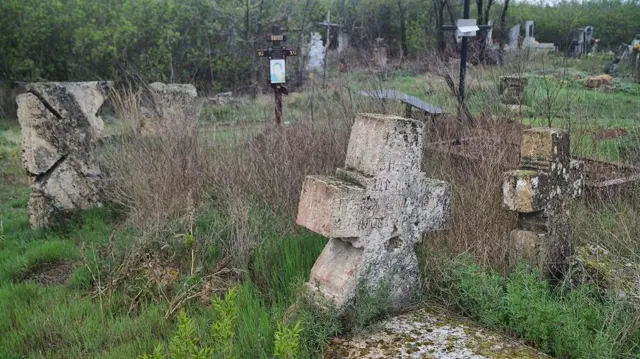
Photo by “Ukraine Incognita”
Ukrainian historian Olga Yadlovska, in her study “The Ethnic Composition of the Rural Population of Southern Ukraine on the Eve of 1917,” writes that during the 18th-19th centuries, the southern Ukrainian region was indeed formed as a multi-ethnic one.
And despite the significant presence of other nationalities (especially in the cities), including Russians, Jews, Bulgarians, German colonists, and others, the majority here were still Ukrainians.
“The most numerous [nation] was the indigenous Ukrainians, and they constituted a significant majority of the entire composition of the Ukrainian provinces,” notes Olga Yadlovska.
Direct evidence of this, as Roman Malenkov says, is the old Ukrainian cemeteries in the Odessa, Mykolaiv, Kherson, and Zaporizhia regions.
“The cemeteries of southern Ukraine are undeniable material proof of the Ukrainianness of the region,” he says.
On the map of “Ukraine Incognita,” the Ukrainian Black Sea region is indeed covered with dozens of cemetery markers with “paw-shaped” crosses, which the organization was able to investigate or at least obtain data about before the start of the full-scale war.
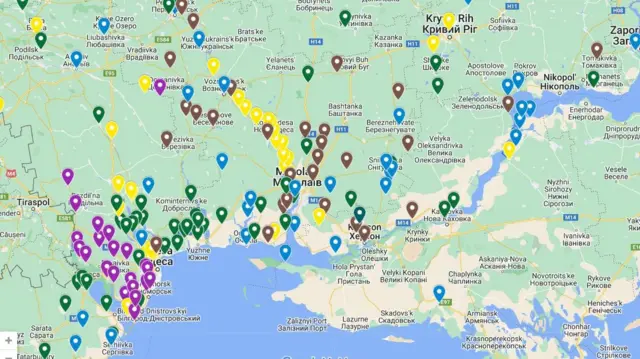
Photo by “Ukraine Incognita”
Roman Malenkov recalls how in 2015 he ended up in the village of Zagnitkiv in the north of the Odessa region near the border with Moldova and saw many old limestone “Cossack crosses” there.
“This was a settlement of Cossacks who once moved from the Sich after its destruction and were engaged in limestone mining. Having become quite skilled craftsmen, they made crosses on graves with carvings, fonts, and images of biblical plots. After that, we started traveling around southern Ukraine and in almost every second village, ancient crosses were preserved - those of the Cossacks and their descendants,” says Roman.
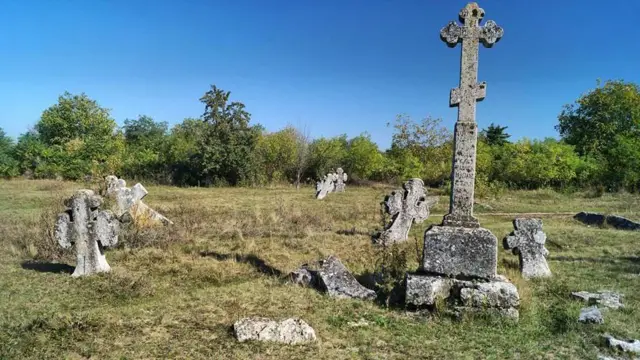
Photo by “Ukraine Incognita”
As for eastern Ukraine, “Ukraine Incognita” cannot currently explore old cemeteries there due to fighting.
Although sometimes information and photos about old burials are sent from there by the military - the map mentions cemeteries near Maryinka, Severodonetsk, and Pokrovsk.
“In these territories in the 18th century, Kalmiuska palanka existed. But it is difficult for us to say how many cemeteries of Cossacks and their descendants remain there. All this still needs to be studied,” Roman Malenkov admits.
Kalmiuska palanka is an administrative association of Zaporizhian Cossacks in the Kalmius River basin in Donbass, centered on the site of modern Mariupol, where the Domakha fortress was then located.
The palanka consisted of dozens of villages, slobodas, hamlets and winter quarters, on the site of which, quite likely, there are remains of unexplored Cossack burial grounds.
Cemeteries as portals to the past
The vast majority of ancient cemeteries in Ukraine are not registered or protected by law as monuments.
“Many Ukrainian crosses are unique. They were not factory products, but the imagination of craftsmen. That is why we have such a variety of cross shapes. Even before the 1920s, there were craftsmen who worked with a chisel and other rather primitive tools, but created amazing products,” says Roman Malenkov.
According to him, in other countries such cemeteries are treated "like a treasure.".
For example, Armenia was able to include its traditional stone tombstones, “khachkars,” in the UNESCO World Heritage List. The Balkans have also managed to do the same with their ancient burial grounds, called “stečki,” most of which are located in Bosnia and Herzegovina.
“But our old cemeteries are not even listed in the register of monuments. They are destroyed by tractor drivers, trees fall on them, they become overgrown with thickets and gradually disappear,” complains Roman Malenkov.
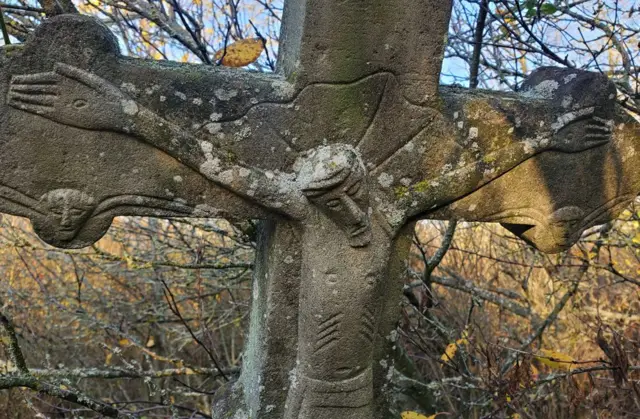
Photo by “Ukraine Incognita”
The Ministry of Culture says that in fact there are a number of old burial grounds in the State Register of Immovable Monuments of Ukraine. But there is no separate register of cemeteries.
Therefore, “Ukraine Incognita” insists that at least an official list of ancient cemeteries with information about them is needed.
“In some areas of old cemeteries, people may not appear for decades because everything is overgrown. But that's where the old stone crosses stand. How can anyone find out about them? If most of the locals don't know who is buried there, and the generation that knew it has already died or its last representatives are too old to remember,” explains Roman Malenkov.
Another step should be to educate local communities on how to handle old burial grounds, how to preserve them, restore them, and transform them into cultural spaces.
“These can be very visited sites, such as a cemetery in the middle of a forest on the site of the Ukrainian village of Stare Brusno in Poland, where tourists go,” notes the head of “Ukraine Incognita.”.
"Old cemeteries are a kind of "portals" that transport us to past centuries. This is the material that remains from our ancestors and that connects us with them, and thus connects Ukrainian history," summarizes Roman Malenkov.
