
The history of the building at 33 Korolenko Street (formerly and now Volodymyrska Street) dates back to 1912, when the Kyiv Provincial Zemstvo Board decided to build a representative office building. For this purpose, an architectural design competition was held, and the famous metropolitan architect Volodymyr Shchuko won. His design combined a symmetrical facade, an attic, and a two-story tower like the baroque bell towers of Kyiv. The first symbolic stone was laid by Olga Stolypina, the widow of the reformer Pyotr Stolypin, and the second by Prime Minister Volodymyr Kokovtsov.
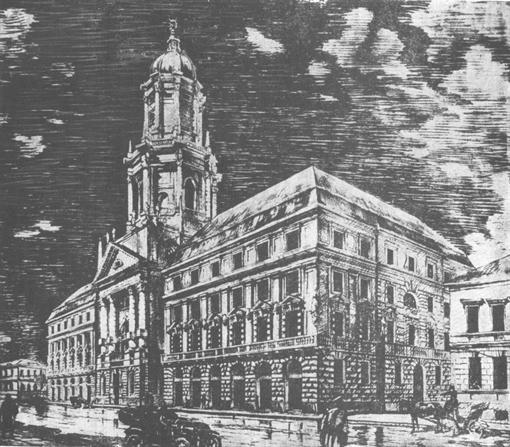
Construction began actively, part of the premises was ready by 1914, but the First World War and the events of 1917 did not allow the work to be completed. Already in the Soviet period, the building was completed, but it was decided to abandon the tower. The building was called the Palace of Labor and served as a center of the trade union movement: a library, a theater box office, a physical education office operated here, lectures, concerts and film screenings were held.
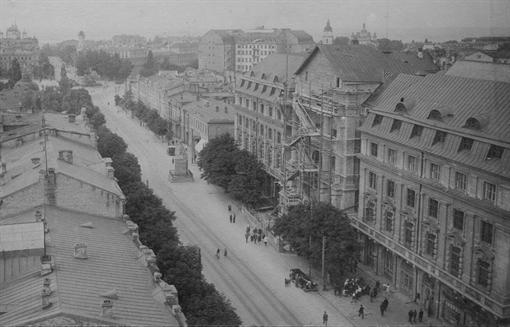
After 1934, the building became the residence of the main authorities of the Ukrainian SSR. The Central Committee of the Communist Party of Ukraine (Bolsheviks) and the Central Committee of the Komsomol were located here, and later the state security organs. During the German occupation, the building was used by the Gestapo. Soviet underground members, Ukrainian patriots, and famous dissidents, including Vasyl Stus, Olena Teliga, and Ivan Svitlychny, were housed within its walls.
The fate of Sergei Korolev is no less interesting: the young future spacecraft designer received documents here in 1924 that allowed him to continue his studies at the Kyiv Polytechnic Institute and took the first step towards an outstanding career.
Thus, the building at 33 Korolenko Street witnessed key events in the history of Kyiv – from zemstvo councils to trade unions, from Soviet repressions to the struggle of dissidents, while remaining a significant cultural and historical object of the capital.